

Acne is a common skin condition that affects millions worldwide, often leaving behind unwanted reminders long after the active breakouts have subsided. These lingering imperfections are frequently, and mistakenly, grouped under the umbrella term "acne scars." However, there's a crucial distinction between acne scars and acne marks, and understanding this difference is the first step toward effective treatment. While both can be frustrating, their underlying causes and appropriate remedies vary significantly.
Understanding Acne Marks (Post-Inflammatory Hyperpigmentation and Erythema)
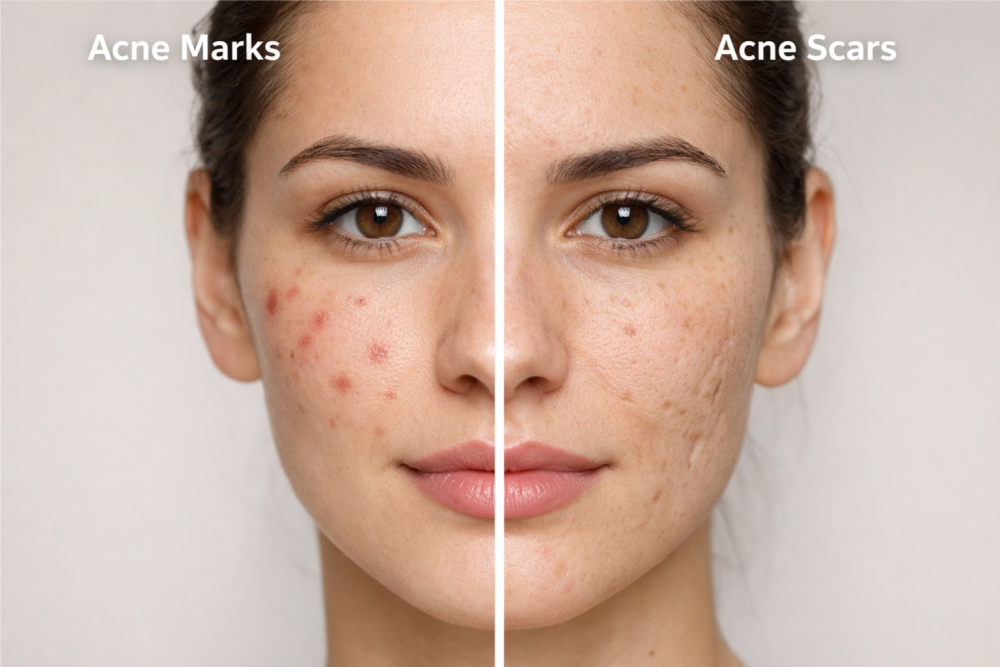
Acne marks are typically temporary discolourations of the skin that appear after an acne lesion has healed. They are not true scars in the sense of permanent tissue damage, but rather a response of the skin to inflammation. There are two primary types of acne marks:
Post-Inflammatory Hyperpigmentation (PIH)
Post-inflammatory hyperpigmentation (PIH) manifests as flat, dark spots ranging from brown to black, or even purple, on the skin. These occur when the skin produces excess melanin (the pigment that gives skin its colour) in response to inflammation or injury, such as a pimple. PIH is more common in individuals with medium to darker skin tones, as their melanocytes (melanin-producing cells) are more active. While PIH can be stubborn, it generally fades over time, though this process can take several months to a year or more.
Post-Inflammatory Erythema (PIE)
Post-inflammatory erythema (PIE), on the other hand, appears as flat, red or pink spots. This type of mark is caused by damage to the tiny blood vessels (capillaries) near the skin's surface during the inflammatory process of an acne lesion. PIE is more prevalent in individuals with lighter skin tones. Like PIH, PIE is not a true scar and will eventually fade, but it can also be a lengthy process.
Understanding Acne Scars
Unlike acne marks, acne scars represent permanent changes in the skin's texture due to significant damage to the collagen and elastin fibers during severe inflammatory acne. When a deep pimple heals, the skin attempts to repair the damage, but sometimes this repair process is imperfect, leading to either an overproduction or underproduction of tissue. This results in an uneven skin surface.
Acne scars are broadly categorized into two main types:
Atrophic Scars (Depressed Scars)
Atrophic scars are the most common type of acne scar and are characterised by depressions or indentations in the skin. They occur when there is a loss of tissue during the healing process. There are three subtypes of atrophic scars:
Icepick Scars: These are narrow, V-shaped scars that penetrate deep into the skin, resembling a puncture from an icepick. They are often difficult to treat due to their depth.
Boxcar Scars: These are round or oval depressions with sharp, defined vertical edges, similar to chickenpox scars. They are wider and shallower than icepick scars.
Rolling Scars: These scars create a wave-like or undulating appearance on the skin. They are typically wide and shallow, with sloping edges, and are caused by fibrous bands under the skin pulling the epidermis downwards.
Hypertrophic and Keloid Scars (Raised Scars)
Less common than atrophic scars, hypertrophic and keloid scars are raised, firm scars that result from an overproduction of collagen during the healing process.
Hypertrophic Scars: These are raised scars that remain within the boundaries of the original acne lesion.
Keloid Scars: These are more severe raised scars that extend beyond the borders of the original wound, often growing larger than the initial lesion. Keloids are more common in individuals with darker skin tones and have a genetic predisposition.
How to Treat Both Acne Marks and Acne Scars
The approach to treating acne marks and scars differs significantly due to their distinct nature.
Treating Acne Marks (PIH and PIE)
Since acne marks are primarily discoloration, treatments focus on speeding up cell turnover, reducing inflammation, and inhibiting melanin production.
- Topical Treatments: Ingredients like retinoids (retinol, tretinoin), vitamin C, azelaic acid, niacinamide, and alpha hydroxy acids (AHAs) like glycolic acid can help exfoliate the skin, promote cell regeneration, and lighten dark spots. Sunscreen is crucial to prevent further darkening of PIH.
- Chemical Peels: Superficial chemical peels, using AHAs or salicylic acid, can help to exfoliate the top layers of the skin, reducing the appearance of PIH and PIE.
- Laser and Light Therapies: Non-ablative lasers (like IPL or pulsed dye laser) can target redness (PIE) by reducing blood vessel visibility, while certain fractional lasers can help with PIH.
Treating Acne Scars
Treating true acne scars often requires more intensive procedures aimed at remodeling collagen, filling depressions, or flattening raised tissue.
- Atrophic Scars:
- Microneedling: This procedure uses tiny needles to create controlled micro-injuries in the skin, stimulating collagen production and improving skin texture.
- Laser Resurfacing: Ablative lasers (e.g., CO2, Erbium YAG) remove thin layers of skin, promoting new collagen formation. Non-ablative fractional lasers stimulate collagen without removing the top layer of skin.
- Chemical Peels (Medium to Deep): Stronger chemical peels can penetrate deeper to improve the appearance of atrophic scars.
- Dermal Fillers: Hyaluronic acid fillers can be injected into depressed scars to raise them to the level of the surrounding skin, offering immediate but temporary improvement.
- Subcision: This technique involves using a needle to break up fibrous bands that pull down rolling scars, allowing the skin to rise.
- Punch Excision/Grafting: For deep icepick or boxcar scars, surgical removal of the scar tissue followed by suturing or grafting healthy skin can be an option.
- Hypertrophic and Keloid Scars:
- Corticosteroid Injections: Injections of corticosteroids can help to flatten and soften raised scars.
- Silicone Sheets/Gels: Applying silicone products can help to reduce the size and redness of raised scars.
- Cryotherapy: Freezing the scar tissue can help to reduce its size.
- Laser Therapy: Certain lasers can help to reduce the redness and flatten hypertrophic and keloid scars.
- Surgical Excision: In some cases, surgical removal of the scar may be considered, often combined with other treatments to prevent recurrence.
Prevention is Key
The best way to deal with acne marks and scars is to prevent them from forming in the first place. This involves treating active acne effectively and consistently, avoiding picking or squeezing pimples, and protecting your skin from sun exposure. If you are struggling with persistent acne, or if you have concerns about existing marks and scars, consulting a dermatologist or a skincare professional is highly recommended. They can accurately diagnose your skin condition and recommend a personalised treatment plan tailored to your specific needs and skin type. Book your appointment here.