


If you're dealing with acne or persistently congested skin, you've probably tried more than one solution. Pore strips from the pharmacy. A salicylic acid toner that worked for a week. Maybe even a chemical peel you read about on Reddit. And yet the blackheads come back, the texture remains, and your skin still doesn't look or feel truly clear.
The truth is, not all pore treatments are equal, and most popular options don't actually address the root of the problem. This guide breaks down the most common treatments for congested, acne-prone skin in Singapore and explains exactly why a professional extraction facial remains one of the most effective, lowest-risk options available.
The Root Problem: Why Congested, Acne-Prone Skin Is Hard to Treat
Before comparing treatments, it's worth understanding what you're actually dealing with.
Congested pores form when excess sebum, dead skin cells, and environmental debris think humidity, pollution, sunscreen residue — accumulate faster than your skin can shed them. In Singapore's climate, this happens quickly. When the blockage stays below the skin's surface and oxidises, it becomes a blackhead. When it becomes infected with bacteria, it turns into a pimple.
For acne-prone skin, this cycle is relentless. Overactive sebaceous glands mean congestion builds back up quickly. Picking or squeezing at home worsens inflammation and can push bacteria deeper. The result is a frustrating loop of clearing and breaking out, over and over.
Any effective treatment needs to do three things: remove existing blockages thoroughly, reduce the conditions that cause them, and support the skin's barrier so it can regulate itself better over time. Most popular pore treatments only do one of these at best.
Pore Strips: Satisfying, But Superficial
Pore strips are the most widely used at-home pore treatment in Singapore, and it's easy to see why. They're cheap, accessible, and the "before and after" is immediately visible — all that dark gunk pulled out of your nose in one peel.
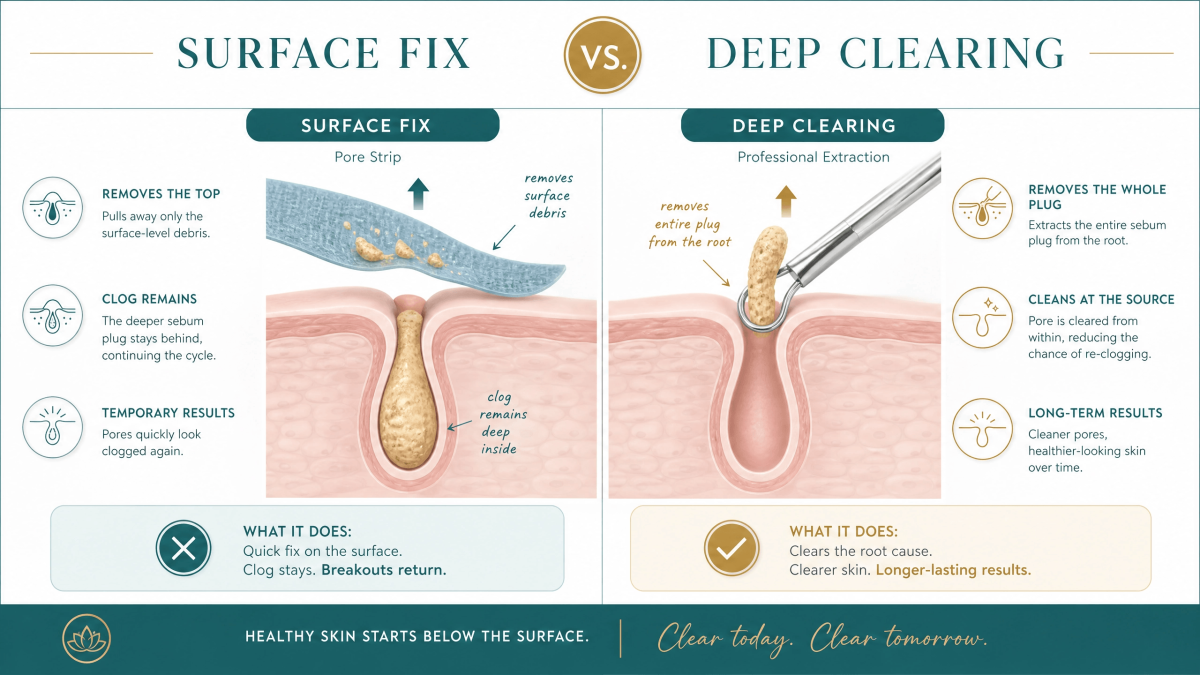
Here's the problem: pore strips only remove the very top of the blackhead. The deeper plug of hardened sebum — the part that actually keeps the pore clogged — stays put. Within days, the oxidised tip reforms. You're essentially trimming a weed at the surface instead of pulling it out by the root.
Worse, for acne-prone skin, the adhesive in pore strips can strip the skin's natural moisture barrier, leading to increased oil production as the skin tries to compensate. Regular use can make congestion worse over time, not better.
Verdict: Fine as an occasional top-up, not a solution for congested or acne-prone skin.
Chemical Exfoliants (BHAs, AHAs): Helpful, But Limited
Salicylic acid (a BHA) has genuine merit for acne-prone skin. It's oil-soluble, meaning it can penetrate into pores and break down the sebum and dead cell mixture that causes congestion. Regular use of a well-formulated BHA can keep mild blackheads under control and reduce active breakouts.
The limitation is depth and specificity. Chemical exfoliants work across the entire face, which is helpful for maintenance, but they can't target a specific deeply clogged pore or remove a fully formed blackhead or milia seed. They also require consistency over weeks to show noticeable results, and for already inflamed or sensitive acne-prone skin, daily acid use can irritate rather than calm.
AHAs (like glycolic or lactic acid) work on the surface and are better suited for texture, dullness, and mild congestion rather than active acne or deep blackheads.
Verdict: A valuable part of a maintenance routine, but not sufficient on its own for moderate to severe congestion.

Chemical Peels: More Powerful, More Risk
Professional chemical peels use stronger concentrations of acids than over-the-counter products to exfoliate the skin more deeply. For acne-prone skin, certain peels — particularly salicylic or mandelic acid peels — can reduce active breakouts and improve overall texture.
However, chemical peels come with meaningful trade-offs for congested or acne-prone skin. The downtime (redness, peeling, sensitivity) can last several days, which isn't ideal for people who need to go about their daily lives in Singapore's humid weather.
During the peeling phase, the skin is especially vulnerable to sun damage and bacterial infection, a particular concern if you're already dealing with active acne.
Peels also don't physically remove existing blockages. They help the skin shed faster, which can dislodge some congestion over time, but a deeply embedded blackhead or milia seed will not be removed by a peel alone.
Verdict: Useful for overall skin renewal, but not targeted enough for congested pores and carries more risk for sensitive or reactive acne-prone skin.
Laser and Light Treatments: Advanced, But Not Designed for This
Laser treatments like Q-switch or certain IPL protocols can target acne bacteria, reduce sebaceous gland activity, and improve post-acne pigmentation. For some acne sufferers, laser can be genuinely transformative.
That said, laser is not a pore treatment in the extraction sense. It doesn't remove existing blackheads, whiteheads, or milia seeds — it can't "reach in" and clear a physically blocked pore. Results take multiple sessions, costs are high, and for sensitive or reactive skin, there's always a risk of post-inflammatory hyperpigmentation, especially for deeper skin tones which are common among Singapore's population.
Laser is best viewed as a complementary treatment for severe or scarring acne, not a frontline solution for congested or moderately acne-prone skin.
Verdict: A specialised tool for certain acne types, not a replacement for direct pore clearing.
Extraction Facial: The Most Direct Solution for Congested, Acne-Prone Skin
A professional extraction facial is the only treatment that physically removes the contents of a clogged pore — completely, and in a controlled, skin-safe way. When performed correctly, it addresses what no topical or energy-based treatment can: the actual blockage itself.
The key phrase is "performed correctly." A well-executed extraction facial for acne-prone skin includes several critical steps that set it apart from a rushed or generic facial:
- Thorough pre-softening: Steam and targeted serums soften the pore opening and loosen the sebum plug before any manual pressure is applied. This is what makes extraction painless and what cheap or rushed facials skip.
- Customised assessment beforehand: Acne-prone skin is not uniform. Some clients present with predominantly blackheads; others with whiteheads, milia seeds, or a combination alongside active inflamed pimples. A skilled therapist reads the skin before treating it, adjusting approach and products accordingly. Active, inflamed acne requires a different technique than congested but non-inflamed skin.
- Gentle, skilled technique: Properly trained therapists use precise, controlled pressure to extract without tearing or bruising the surrounding tissue. The goal is clean extraction — not force. This is especially important for acne-prone skin, where aggressive handling can rupture follicles and cause new breakouts.
- Calming and bacteria-reducing steps after extraction: After clearing congestion, the skin is vulnerable. A professional treatment immediately follows extraction with antibacterial, anti-inflammatory, and pore-closing steps. This is what prevents the redness and breakouts that some people experience after poorly done extractions.
- Consistent follow-up: Unlike a chemical peel or laser session that needs recovery time, a well-done extraction facial leaves the skin calm and clearer within hours. Monthly or bi-monthly sessions keep congestion from rebuilding, progressively improving skin texture over time.
For acne-prone and congested skin specifically, extraction facials work in harmony with not instead of a home care routine. They remove what home products can't, while your BHA toner and moisturiser maintain the progress between sessions.
Verdict: The most direct, targeted, and effective treatment for congested and acne-prone skin when performed by a trained therapist with minimal downtime and no risk of the complications associated with peels or lasers.
A Practical Comparison at a Glance
| Treatment | Removes Blockages Directly? | Suitable for Sensitive/Acne Skin? | Downtime | Lasting Results? |
|---|---|---|---|---|
| Pore Strips | Partially (surface only) | No | None | Days |
| BHA/Chemical Exfoliants | No | Yes (with care) | None | Ongoing with use |
| Chemical Peels | No | Risky | 3–7 days | Moderate |
| Laser / IPL | No | Conditional | Variable | Good for pigmentation |
| Extraction Facial | Yes — fully | Yes (when customised) | Minimal | Builds over time |
What to Look for in an Extraction Facial for Acne-Prone Skin in Singapore
Not all extraction facials are created equal. When acne-prone or congested skin is involved, the stakes are higher — the wrong approach can trigger new breakouts, worsen inflammation, or cause scarring. Here's what to look for:
- Acne and sensitive skin specialisation: Look for a provider who explicitly treats acne-prone and sensitive skin, not just a generic spa offering extraction as part of a standard menu. The technique, products, and post-treatment steps need to be calibrated for reactive skin.
- Skin analysis before treatment: A proper assessment before each session means your therapist can identify whether you have active acne, which areas are congested, and which extraction approach suits your current skin condition rather than applying the same treatment every time regardless of how your skin presents.
- Plant-based, non-irritating formulations: For acne-prone skin that's already prone to reactivity, the products used during a facial matter. Avoid providers who use heavily fragranced or synthetic-heavy formulations that can provoke further breakouts or sensitivity.
- No hard-sell environment: Stress and pressure worsen acne. A good facial experience for acne sufferers should feel calm, consultative, and focused on your skin not on upselling packages.
The right treatment for congested and acne-prone skin isn't the harshest one, it's the most targeted one. An extraction facial done well doesn't just clear your skin for a week; it builds the foundation for consistently clearer, calmer, healthier skin over time.